Crypto
Tools for Crypto Airdrops: From Finding Free Crypto to Automating Multi‑Account Farming
Tools for Crypto Airdrops: From Finding Free Crypto to Automating Multi‑Account FarmingCrypto
Introduction: Why Tools Matter for Crypto Airdrops in 2026
A crypto airdrop is a token distribution event where blockchain projects send free tokens directly to users who meet specific criteria. In 2026, those criteria have become layered and demanding.Recent airdrop campaigns and past distributions from projects such as Arbitrum, LayerZero, and Hyperliquid demonstrate a shift toward rewarding sustained on-chain activity rather than simple social-media tasks. Airdrops can distribute tokens to hundreds of thousands of users in a single event. Projects may use them as an alternative user-acquisition strategy, although their cost-effectiveness and ability to retain users vary significantly between campaigns.
No one can manually track dozens of dApps, snapshot windows, points systems, and claim deadlines across multiple blockchains. That's why this article focuses on concrete tools for crypto airdrops: discovery platforms, eligibility checkers, automation bots, analytics dashboards, ecosystem-specific wallets, and anti-detect browsers for safe multi-accounting.
We're writing this from the perspective of Undetectable.io, a privacy-focused antidetect browser used by airdrop hunters and crypto marketers for multi-account management. You'll see named tools, real numbers, and practical setups - not generic theory.
Fast Track: Essential Airdrop Tool Stack (Skip the Theory)
If you want to start hunting today, grab these four categories of tools before reading further:
- **Discovery tool:**An airdrop aggregator or calendar, such as 3alamiy Web3 or Airdrops.io, combined with a quest platform such as Galxe for participating in individual campaigns across Ethereum, Solana, Cosmos, and L2 networks.
- Eligibility checker: A service like Alpha Drops or Airdropped.link that scans your wallet address for unclaimed or potential airdrops without requiring a wallet connection.
- Notification/automation bot: A notification service such as Drops.bot can monitor public wallet addresses and send Telegram alerts about newly detected eligibility, while automation-oriented tools such as LootBot may perform supported on-chain farming tasks.
- Anti-detect browser: Undetectable.io to create separate browser profiles - each with a unique fingerprint and proxy - for every wallet and exchange you use while farming.
You can download Undetectable.io right now and create your first five browser profiles for free, immediately separating your personal wallets from your airdrop farming and testnet activity.
The rest of this article shows how these tools fit together, chain by chain, from beginner to professional farmer.
How Crypto Airdrops Work Today (And Why Tools Are Non‑Optional)
Early crypto airdrops were simple. Uniswap made at least 400 UNI claimable to addresses that had interacted with its contracts before the September 1, 2020 snapshot, including some addresses whose transactions had failed. Standard airdrops distribute tokens to existing wallet holders. Bounty airdrops require users to perform promotional tasks for tokens, like sharing content on social media. Holder airdrops reward users based on their existing cryptocurrency holdings or token ownership.
By 2023–2026, the mechanics changed dramatically. On March 23, 2023, Arbitrum airdropped approximately 1.2 billion tokens to roughly 625,000 eligible wallets, with eligibility criteria based on protocol interactions, bridging tokens, transaction frequency, and duration of usage. Airdrops can be automated using smart contracts for efficiency, but the qualification rules have gotten far more complex:
- Snapshot mechanics: Projects record on-chain state at specific block heights - your token holdings, staking positions, governance votes, and activity levels all count.
- Points systems: Some protocols, such as Hyperliquid, use points programs, while others, such as LayerZero, determine eligibility through snapshots and historical protocol interactions without publishing a traditional points system.
- Retroactive rewards: Some crypto projects reward early adopters after launch based on historical usage, before a token was even announced.
Airdrops distribute free tokens to users' wallets, but most airdrops now require completing tasks across many dApps and blockchain networks over weeks or months. Active participation on key platforms may yield larger airdrop rewards than simply holding tokens. Airdrop farming often requires interacting with protocols, testnets, or point systems - and that's why tools are non-optional. No spreadsheet can reliably track 30+ campaigns, shifting snapshot dates, and cross-chain eligibility rules.
Discovery Tools: Finding Legit Crypto Airdrops and Potential Campaigns
Discovery tools are platforms that list ongoing and potential airdrops across chains. Airdrop aggregators provide curated lists of potential and active campaigns, saving hours of manual research. Think of them as your radar.
A good discovery tool should offer:
- Filters by chain (Ethereum, Solana, BNB Chain, Cosmos, Base, zkSync)
- Status tags (potential, confirmed, snapshot in progress, claim phase)
- Reward type (cryptocurrency tokens, NFTs, points)
- Protocol quality indicators (TVL, audit status, funding rounds)
NFT airdrops distribute non-fungible tokens as rewards or collectibles, and some discovery platforms list these alongside standard token drops. Exclusive airdrops sometimes target followers of specific airdrop aggregators, so being active on multiple discovery platforms increases your surface area.
Practically, here's how to use them in a daily routine:
- Check your tracker each morning for new airdrops and updated statuses.
- Filter by chains you already use and sort by estimated reward value.
- Add promising campaigns to a personal watchlist (Notion, Airtable, or the platform's built-in tracker).
- Verify listings against project announcements. Airdrop participants should monitor project social media for updates, since aggregators sometimes lag behind official confirmation from the project team.
For deeper strategies on maximizing your returns from these campaigns, see our guide on how to maximize earnings from cryptocurrency airdrop distributions.
Airdrop Eligibility Checkers: See What Free Crypto You've Missed
Eligibility checkers solve a specific problem: they look at your wallet address and tell you which airdrops you can still claim, which you missed, and sometimes what you're on track for in the future.
The typical workflow is simple - paste a public Ethereum, Solana, or Cosmos wallet address, and the tool checks known airdrop contracts and criteria against your on-chain activity.
Alpha Drops supports Ethereum, Solana, and many EVM-compatible chains (zkSync, Scroll, Starknet, and others). It scans over 200 projects and shows both past and live airdrops with estimated values. Airdrop eligibility checkers allow you to verify if a wallet qualifies for unclaimed airdrops without connecting it - no wallet signature required.
Drops.bot covers an even wider range of networks, including Cosmos, Aptos, and SUI. It shows unclaimed drops and can run background checks with optional Telegram alerts for new matches.
Airdropped.link tracks 30+ protocols with notification support via email and Telegram. It's especially useful in Solana ecosystems and offers both free and premium tiers.
Airdrop eligibility can be tracked through dedicated platforms like these. Since airdrops can be claimed within specific time windows, missing a claim deadline can mean losing thousands of dollars in airdropped tokens. Airdrop eligibility can depend on user activity and liquidity provided. Some platforms compare your current activity with publicly known or speculative campaign criteria, but these estimates cannot confirm eligibility for future airdrops.
Always cross-reference checker results with the project's official channels before clicking any claim link.
Automation & Notification Tools: Bots That Hunt Crypto Airdrops For You
As the number of potential airdrops grows, hunters increasingly rely on automation platforms that monitor protocols, track wallet activity, and send alerts when new campaigns or claim windows appear.
LootBot is an example of an automation-oriented crypto tool that can perform supported farming activities across selected networks. Its available chains, campaigns, and notification features should be checked directly before use. Airdrops can reward users for on-chain contributions, and tools like this help you stay aware of when those contributions cross eligibility thresholds. Since airdrops can be claimed within a specific time window after announcements, getting a timely Telegram or Discord notification can be the difference between claiming and missing out.
How these platforms typically work:
- Register or connect your wallet address (public key only).
- Receive alerts via Telegram, Discord, or email for new potential airdrops or claimable tokens received.
- Some platforms include simple on-chain task automation - scheduled swaps, periodic bridge usage, or testnet interactions.
Pros: Time saved, reduced chance of missing deadlines, passive discovery of niche drops from newer crypto projects.
Cons: Subscription cost, custodial vs. non-custodial risk, and the danger of giving bots too much control over your wallets.
Best practices for using automation tools:
- Use separate burner wallets with limited funds for any automated interaction
- Verify every transaction request manually before signing
- Never share seed phrases - not even with seemingly reputable tools
- Learn how to get free tokens in bounty campaigns safely using non-custodial approaches
Dashboards & Analytics: Tracking Airdrop Points, Activity, and Wallet Performance
Analytics dashboards help you visualize your DeFi activity, track accumulated points, and decide whether a protocol is worth farming. They answer the question: "Is this campaign worth my time and gas fees?"
Key metrics to monitor:
| Metric | Why It Matters | Example |
| Protocol TVL | Higher TVL often signals legitimacy | Hyperliquid's TVL growth before its token launch |
| Token distribution allocation | Shows what % goes to community members | LayerZero allocated 38.3% for community participation |
| Historic airdrop results | Benchmarks expected value | Arbitrum's ~1.2B tokens distributed across 625K wallets |
| Your accumulated points | Tracks your standing | Hyperliquid's point system across testnet + mainnet |
| Gas costs vs. estimated reward | Determines ROI | Some L2 tasks cost under $1 in gas but yield hundreds |
Hyperliquid's airdrop in November 2024 distributed roughly 310 million HYPE tokens - about 31% of total value of its supply - to approximately 94,000 wallets, with rewards based on point accumulation from testnet, mainnet usage, and referrals.
Serious airdrop hunters build tracking sheets with columns for protocol name, chain, points earned, estimated allocation, risk level, and time required. Combining dashboards like DeFiLlama and Dune Analytics with personal spreadsheets or Notion boards creates a command center for coordinating farming strategies across dozens of protocols.
Airdrop Management & Tracking Tools: Watchlists, Status Tags, and History
After a few months of active farming, you'll easily juggle 30+ protocols. Without a management system, campaigns blur together and deadlines slip.
Effective management tools offer:
- Watchlist for projects you're actively farming
- Color-coded flags for priority or risk level
- Status labels: Potential → Confirmed → Snapshot → Verification → Reward Available → Distributed
- Custom notes per campaign (e.g., "snapshot expected Q4 2026," "requires KYC," "no U.S. users," "must provide liquidity on this chain")
- Deadline reminders for claim windows
- Grouping by chain or type (DeFi, NFT, Layer 2, Cosmos zones)
Some platforms let users tag campaigns as airdrop based on trading volume tiers, long-term wallet activity, or community engagement requirements. These features help you align your behavior with complex eligibility rules so you don't waste effort on campaigns where you won't qualify.
For multi-account airdrop farmers, combining these management features with an antidetect browser for Mac and Windows keeps each identity, wallet, and project cleanly separated. Each browser profile in Undetectable.io can be tagged and organized alongside your campaign tracking - one profile per wallet persona, one proxy per region, one set of cookies per dApp ecosystem.
Specialized Tools by Ecosystem: Ethereum, Solana, Cosmos, and Beyond
Tools are often chain-specific, and using the right tool for each ecosystem improves your airdrop eligibility and safety. Most airdrops require a compatible self-custodial wallet for participation - using self-custodial wallets is crucial for qualifying.
Ethereum & EVM Chains
Eligibility checkers like Alpha Drops and Drops.bot support Ethereum and EVM-compatible L2s (Arbitrum, Base, Optimism, Polygon). MetaMask remains the standard wallet. Many projects run ongoing points systems. LayerZero, however, based its initial retroactive distribution on historical activity across its protocol and connected applications rather than a publicly visible points program. Many projects on Ethereum reward users who pursue airdrops through consistent protocol interactions across DEXs, lending platforms, and bridges.
Solana
Solana's ecosystem features XP-based systems from platforms like Backpack and Meteora. Tools like Airdropped.link are strong here. The 2024 WEN airdrop and Meteora's MET Season 2, which began tracking activity from July 1, 2025, demonstrated how Solana campaigns can reward participation across multiple ecosystem applications. Wallets like Phantom and Backpack are standard. Many Solana token launches combine NFT drops with fungible token distribution.
Cosmos Ecosystem
The Cosmos ecosystem requires IBC usage, staking, and governance voting for most drops. Leap Wallet and Keplr are the main compatible wallets, with Leap offering built-in airdrop checker pages for Cosmos Hub, Osmosis, and other zones. Existing tokens like ATOM often need to be staked and used for governance votes to qualify. Users who hold ATOM on centralized exchanges may be ineligible or unable to claim because they do not control the underlying wallet address. Users of self-custodial wallets may sometimes need to access the same address through Keplr or Leap to use a project's claim interface.
Other Ecosystems
zkSync, Base, Abstract Chain, and omnichain protocols like LayerZero require activity across multiple blockchains, making interoperability-aware tools crucial. A single blockchain focus won't cut it anymore - cross-chain activity is increasingly the baseline for eligibility across many new crypto coins and protocols.
Multi‑Account & Anti‑Detect Browsers: Scaling Airdrop Farming Safely
Advanced airdrop hunters use multiple wallets and identities to diversify risk and capture more potential airdrops. But protocols run anti-Sybil detection systems that cluster accounts by browser fingerprint, IP address, usage patterns, and behavioral signals. If you use the same browser profile for dozens of wallets, you're painting a target on every single one.
Browser fingerprinting includes canvas rendering, WebGL output, installed fonts, hardware concurrency, audio context, screen resolution, timezone, and locale. Anti-Sybil systems use these signals to determine whether "different" wallets actually belong to the same person.
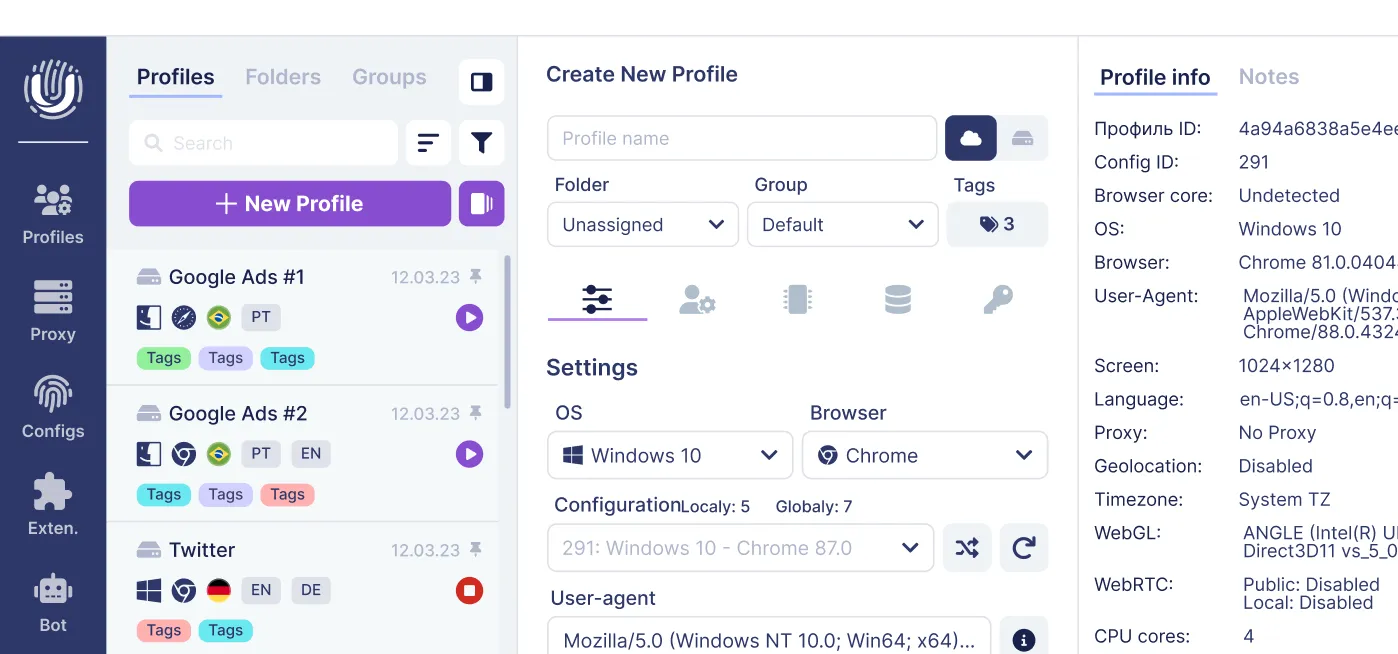
Undetectable.io is an anti-detect browser built for exactly this scenario:
- Separate browser profiles - each with its own unique fingerprint drawn from a store of real device configurations
- Local profile storage - your data stays on your device, not on external servers, giving you full control. Unlimited local profiles on any paid plan
- Per-profile proxy management - assign a different residential or mobile proxy to each profile using reliable premium proxy services so network identities don't overlap
- Cookies bot - warms up new profiles by visiting popular sites and generating realistic browsing history, reducing "fresh account" red flags
- Local API - automate profile creation, proxy assignment, and browser launches via scripts for repetitive farming workflows
Dedicated privacy tools, such as VPNs or burner wallets, can enhance security for airdrop participation. Dedicated wallets should be used for airdrop participation to avoid scams - and each wallet should live inside its own browser profile.
Airdrop hunters typically create distinct profiles for each persona: DeFi trader, NFT collector, Cosmos staker, testnet user. Each profile gets a matched proxy (location, timezone, language), ensuring consistency that passes fingerprint checks.
Ready to scale your farming? Download Undetectable.io for Windows or macOS, create multiple profiles, and start separating your personal investing, airdrop farming, and testing accounts today.
Security and Anti‑Fraud Tools: Staying Safe While Chasing Free Crypto
Free crypto always attracts scammers. Airdrops can expose users to scams and fraud, and the tools you use for protection matter just as much as the ones you use for discovery.
Must-Use Security Layers
- Hardware wallets (Ledger, Trezor) for any significant holdings - never keep large balances in hot wallets used for farming
- Segregated hot or burner wallets for interacting with unverified dApps
- Browser security extensions that flag phishing sites and malicious smart contract approvals, plus periodic checks on BrowserLeaks-style anonymity tests to confirm your setup isn’t leaking IP, DNS, or fingerprint data
- Block explorers (Etherscan, Solscan, Mintscan) to verify contract addresses before signing any transaction
Common Airdrop Scam Patterns
- Fake claim websites asking for seed phrases
- Malicious token approvals that grant unlimited allowance to drain existing wallets
- Fake "exclusive airdrop" DMs on Telegram or X linking to copycat sites
Most users on Reddit strongly advise verifying all airdrop links via official social media channels. It's essential to verify claim announcements through the project's official website before clicking links, and to regularly run Whoer.net-style anonymity checks to ensure your IP, DNS, and fingerprint aren’t exposing your main identity. Airdropped assets may become worthless after distribution, but getting scammed is far worse than missing a low-value drop.
An antidetect browser like Undetectable.io helps segment risk: one low-value wallet per profile, untrusted dApps isolated from main holdings, and the ability to clear cookies and fingerprints when interacting with unknown projects; power users can also compare GoLogin alternatives for multi-accounting to choose the right antidetect setup for their workflow.
Regulatory Considerations
Airdrops often require KYC verification for participation, especially for U.S.-facing projects. In the U.S., received airdropped tokens may constitute taxable ordinary income when the recipient obtains dominion and control over them. The treatment can depend on the circumstances, so participants should maintain records and consult current tax guidance. Weigh the data exposure against the expected reward before submitting personal information to any platform.
Building a Practical Airdrop Tool Stack: From Beginner to Power User
Instead of chasing every new tool, assemble a coherent stack that matches your time, risk tolerance, and goals.
Beginner Setup
- One main non-custodial wallet (MetaMask for EVM, Phantom for Solana)
- A simple airdrop discovery site and one eligibility checker
- Basic spreadsheet or Notion board to track 5–10 projects
- Verify everything manually - this is where you build instincts
Intermediate Setup
- Multiple wallets segmented by chain and purpose
- A notification bot (Lootbot or similar) plus 1–2 analytics dashboards
- An anti-detect browser like Undetectable.io to cleanly separate work, investing, and airdrop activities with proxy management
- More structured tracking: status tags, deadline reminders, chain groupings
Power User / Professional Farmer
- 10–50+ browser profiles with different fingerprints and proxies via Undetectable.io (unlimited local profiles on paid plans)
- Dedicated dashboards for each major ecosystem (Ethereum, Solana, Cosmos, L2s)
- Automation scripts via Undetectable.io's API to manage browser profiles and repeat supported workflows at scale, while keeping transaction signing and wallet security under manual control
- Advanced features like mass profile creation, proxy import/export, and cookies bot warming
- A more efficient way to manage everything: combining management tools with per-profile wallet isolation
Start with the beginner stack. Add tools only when your campaigns and potential airdrops portfolio grows enough to justify the cost and complexity. Many successful farmers ran simple setups for months before scaling - the key is consistency, not tool count.
Case Studies: How Tools Made or Broke Past Airdrop Gains
Understanding concrete wins and misses from past airdrops shows exactly where tools add the most value.
Case Study 1: Arbitrum
On March 23, 2023, Arbitrum airdropped approximately 1.2 billion tokens to around 625,000 users. Early users who tracked their Arbitrum usage via dashboards and calendars had been actively using the L2 for months - bridging tokens, using DEXs, and interacting with dApps. They maximized eligibility by maintaining consistent activity. Those without eligibility checkers or discovery tools could miss the claim window entirely or fail to realize they were eligible before the claim period ended. The drop rewarded more users who showed genuine community engagement over time.
Case Study 2: LayerZero
LayerZero's ZRO airdrop in June 2024 reached approximately 741,986 claimers with a median claim value of roughly $130 per eligible wallet and a total value claimed of about $192 million. Users who relied on ongoing usage tracking tools and notifications stayed active across Stargate and other connected apps through multiple seasons. They earned more points and received larger allocations. Farmers who stopped after the first season and missed later community allocations learned an expensive lesson: in seasonal drop programs, consistency matters more than intensity.
Case Study 3: Cosmos Ecosystem
Cosmos users leveraging Leap Wallet's checker plus chain-specific dashboards claimed multiple staking-based airdrops over 2023–2025. By maintaining watchlists with status tags and snapshot date reminders, they avoided missing critical windows. One common failure pattern: users who held ATOM on centralized exchanges or non-native wallets couldn't claim because those platforms didn't support IBC-based claims. The tool choice - and wallet choice - was the deciding factor between receiving free crypto and watching it go to someone else.
Each case shows the same pattern: discovery, analytics, eligibility checkers, notification bots, and proper wallet/browser separation were the tool categories that made the difference.
Conclusion: Choosing the Right Tools for Your Airdrop Strategy
Crypto airdrops can be lucrative, but they're competitive, time-sensitive, and increasingly sophisticated. No single tool covers everything. The hunters who consistently profit are the ones who build a deliberate stack: discovery sites to find new airdrops, eligibility checkers to avoid missing claims, automation bots to catch deadlines, analytics dashboards to prioritize effort, ecosystem-specific wallets that actually work with claim mechanisms, and anti-detect browsers to manage multiple wallets without getting flagged.
Undetectable.io fills a critical gap in this stack. It gives you privacy-friendly multi-profile browser management with per-profile fingerprints, local storage for full data control, proxy assignment per identity, and API-driven automation - all the infrastructure you need to scale from casual participant to professional-grade airdrop farmer.
The difference between someone who occasionally picks up airdropped tokens and someone who consistently captures value from every major token distribution comes down to preparation and tools. Start today: pick one discovery tool, one eligibility checker, and download Undetectable.io to create your first profiles. Then scale from there.
Related posts
View all articlesJoin 450,000+ users who chose Undetectable
- Advanced anti-detection technology
- Unlimited local profiles from $49
- The perfect solution for multi-accounting